
David Elliman
Global Chief of Software Engineering
Alzheimer’s remains one of the most complex diseases to understand, diagnose and treat. Its biology unfolds over many years, often long before symptoms appear. Researchers are also working against the practical challenge that the brain is difficult to access directly, while the most useful data is often fragmented, sensitive, or simply scarce.
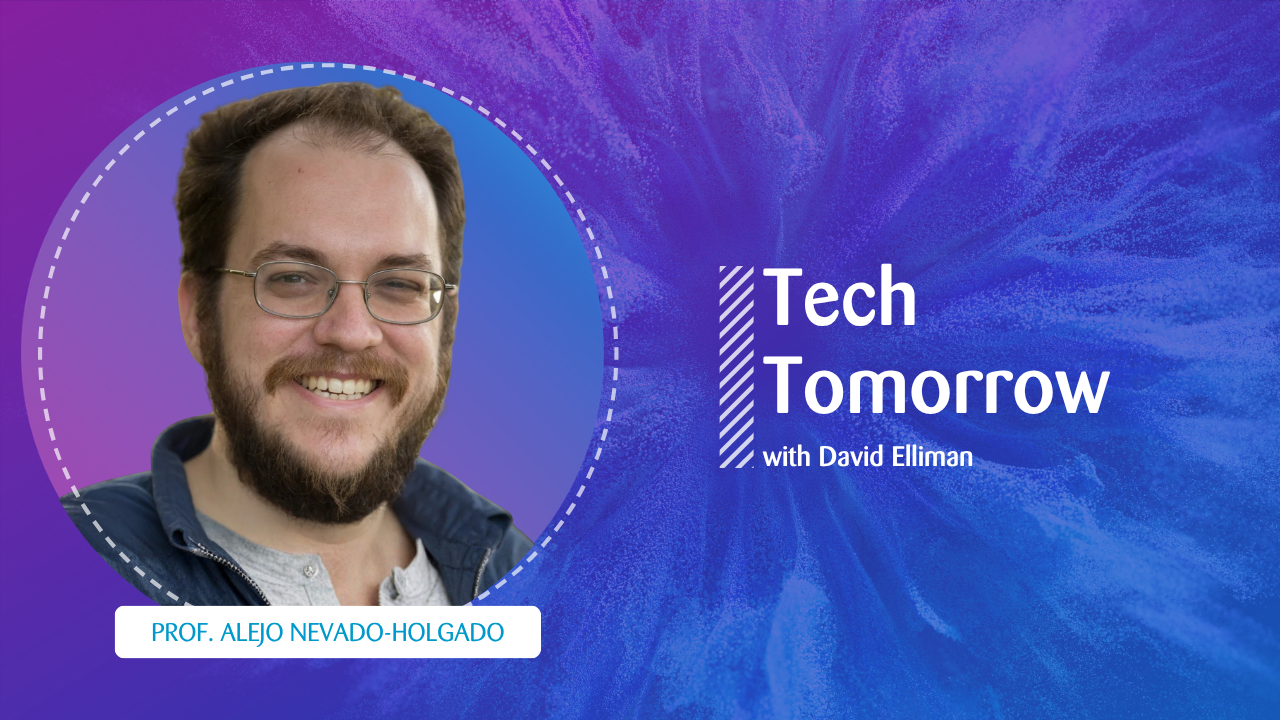
In this episode of Tech Tomorrow, David Elliman and Professor Alejo Nevado-Holgado explore if AI and data science can help us find a cure for Alzheimer’s.
Meet the guest: Alejo Nevado-Holgado
Alejo Nevado-Holgado is an Associate Professor in the Department of Psychiatry and the Big Data Institute at the University of Oxford, where he co-leads an interdisciplinary lab applying AI, bioinformatics and wet-lab methods to neurodegenerative disease research.
His work sits at the intersection of computational modelling, molecular neuroscience, and translational medicine, which makes him an ideal guest for a conversation about where AI can deliver real value in Alzheimer’s research.
Key takeaways from the episode
Alzheimer’s is exactly the kind of problem that exposes both the promise and limits of AI
One of the clearest points in the episode is that Alzheimer’s is not a simple 'more data, better answers' problem. The disease begins developing many years before symptoms become visible, which means researchers are often trying to reconstruct the earliest causes from much later-stage evidence. If we add the blood-brain barrier, limited access to brain tissue, and the messy reality of human biology, it becomes obvious why progress is slow.
That is also why AI needs to be framed carefully. In Professor Nevado-Holgado’s view, AI is not a substitute for biology, clinical judgement, or experimentation. It is one tool in a much wider research toolbox. Its value lies in handling combinations, correlations, and patterns at a scale that more traditional approaches cannot manage efficiently.
Earlier detection may be one of AI’s most meaningful contributions
If there is one area where the potential feels especially tangible, it is early detection. Professor Nevado-Holgado discusses the growing role of blood-based biomarkers in spotting signs of disease long before traditional diagnosis is possible. That matters because even the most promising treatments are likely to have more impact when intervention happens earlier, before significant brain deterioration has taken place.
And Alzheimer’s research is already moving in this direction. UK Biobank now provides researchers access to data from half a million volunteers, creating opportunities to study relationships across genetics, imaging, blood markers and clinical history at an unprecedented scale. For leaders in health and life sciences, the strategic point is bigger than Alzheimer’s alone. If AI can help surface disease signatures earlier from less invasive data, then the impact could extend across diagnostics, patient stratification, and trial design.
Better models only matter if they are built on the right data foundations
A strong thread through the episode is that the challenge is not simply to apply AI to Alzheimer’s research, but to apply it to the right kinds of data in the right way. Professor Nevado-Holgado points to genomics as one particularly promising area: instead of looking at only the most common mutations one by one, more advanced models can begin to explore far more combinations across the genome. That creates the possibility of uncovering associations and pathways that were previously invisible.
But this depends on data quality, accessibility and thoughtful modelling choices. In other words, success starts long before anyone trains a model. The same principle shows up across biotech innovation and pharma innovation: AI tends to create value when organisations treat data as strategic infrastructure rather than an afterthought.
There is also a useful case-study connection here. In Global Research Platforms and Zühlke are fighting Alzheimer’s disease, the focus is not on flashy algorithms, but on reducing barriers to secure data access and enabling collaboration around sensitive Alzheimer’s datasets. That is exactly the sort of practical foundation breakthrough research depends on.
Explainability is still a real issue, especially in healthcare
Another valuable part of the conversation is its honesty about uncertainty. AI can spot patterns that humans would struggle to find, but that does not automatically mean we understand why a model is reaching a particular conclusion. In high-stakes domains such as healthcare, that matters. Researchers and decision-makers need confidence, not just output.
This is why the episode’s most mature message may be its simplest: trust in AI should be earned through track record, testing, and human oversight.
AI could accelerate drug discovery, but it will not remove the need for science
The episode also explores one of the most exciting possibilities: using AI to speed up molecular simulation and drug discovery. Professor Nevado-Holgado describes how traditional all-atom simulations are often far too slow to model biologically relevant interactions at the timescales researchers actually care about. Neural networks may help bridge some of that gap, making it easier to simulate how molecules behave and whether a potential therapy could interrupt harmful processes such as amyloid aggregation.
That does not mean a cure is around the corner. But it does mean AI could make the search process more efficient — helping researchers prioritise experiments, narrow options faster, and potentially identify promising candidates that would otherwise be missed. It is also worth noting that the wider treatment landscape is beginning to shift. The FDA’s approval of lecanemab has been seen as an important milestone, even if debate continues about the scale and implications of that benefit.
This more nuanced, hybrid picture feels much closer to reality. AI may help researchers move faster and see further, but laboratory science, clinical validation and human expertise remain non-negotiable.
“I think that AI is not going to replace everything, so to speak, but it is a new tool that might be very useful for research on Alzheimer's disease. It is a tool that can be potentially applied to everything, but that probably in the end, there'll be only a proportion of places where it will be applicable.”
So, can AI and data science help us find a cure for Alzheimer’s?
Yes, but probably not in the way the loudest headlines suggest. This episode lands on a more useful conclusion: AI is unlikely to “crack” Alzheimer’s by replacing researchers or automating the entire discovery pipeline. Its real role is more practical, and arguably more powerful: helping scientists detect disease earlier, interpret complex biological signals, test hypotheses faster, and make better use of limited and sensitive datasets.
That may sound modest, but it is not. In a field where every earlier signal, every clearer pathway and every better-targeted experiment can change the odds, those gains matter enormously. The real opportunity is artificial intelligence making human discovery more effective.