Digital strategy
Securiton drives scalability and cost efficiency
Learn more
Industrial sector
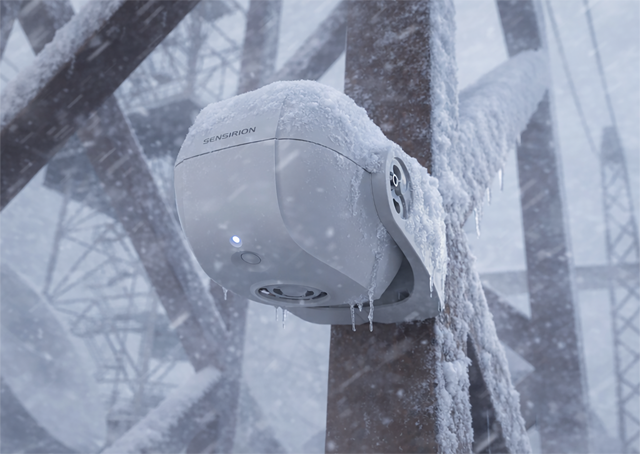
In a record time of 12 months, Sensirion Connected Solutions and Zühlke developed an explosion-proof, autonomous methane monitoring system for onshore and offshore oil and gas facilities. Nubo Sentry detects even the smallest leaks and is low-maintenance, wirelessly integrated, and designed for series production. Operators benefit from improved emissions transparency, reduced operating costs, and enhanced safety.
Methane emissions are coming under increasing scrutiny due to regulatory requirements, ESG reporting, and operational risk considerations. For operators of oil and gas facilities, this means leaks must be detected earlier, located more precisely, and resolved more quickly under extreme environmental conditions and in hazardous areas.
Existing systems are often either insufficiently sensitive to detect very small leaks or not suitable for use in explosive atmospheres. Others function reliably from a technical perspective but are labour-intensive and only used periodically.
Sensirion Connected Solutions defined a clear vision: develop Nubo Sentry – a system capable of measuring methane with high sensitivity directly at potential leak sources, operating autonomously and safely. Our team took on the end-to-end system development with the goal of transforming a sensor concept into an industrial-grade, certifiable, and scalable product.
“Zühlke integrated seamlessly into our team and contributed its strong multidisciplinary expertise to deliver a business-critical project in just twelve months, significantly faster than usual and without compromising on quality.”
From the outset, the system was consistently designed for real-world operating conditions. The objective was to further develop an existing sensor concept so that it:
This combination of performance, robustness, safety, and scalability guided every decision throughout the project.
Our team was responsible for the system architecture, integrating mechanics, electronics, power supply, and safety requirements into a coherent overall concept. Intrinsic safety, energy limitation, and thermal analyses were embedded into the architecture from the beginning, not added later.
With this holistic systems engineering approach, the project team reduced technical risks early and laid the foundation for efficient certification in accordance with international standards such as ATEX, IECEx and Class I Div 1.
Deployment locations in the oil and gas industry, both offshore and at remote onshore sites, are difficult to access, making service operations costly. For this reason, the system’s energy architecture is designed for maximum efficiency.
Through an optimised combination of primary cells, energy-efficient measurement strategies and intelligent data transmission, Nubo Sentry can operate for up to five years without maintenance or battery replacement, an essential factor for economic viability in the field.
For operators, this translates into significantly reduced operating costs, fewer unplanned interventions and higher asset availability.
The housing concept meets high protection standards and withstands moisture, dust and mechanical stress.
At the same time, the team aligned the design early on with series production requirements, including injection moulding design, manufacturing concepts, and support for industrialisation. This ensured not just a functional prototype, but a scalable product platform ready for international rollout.
The architecture of Nubo Sentry is driven by one central principle: maximum impact with minimal installation effort.
The solution combines highly sensitive optical measurement technology with long-term autonomy, wireless integration via LoRaWAN and Bluetooth, and intrinsic safety. The system detects even very small methane emissions at an early stage directly at the source before they become safety-critical.
Operators can sustainably reduce their emissions and provide measurable proof of these reductions, enabling them to meet ESG targets and regulatory requirements efficiently and transparently. At the same time, they establish the foundation for scalable, data-driven monitoring across entire facility portfolios.
The collaboration between Sensirion and Zühlke demonstrates how integrated engineering, safety expertise, and industrialisation capabilities come together to transform a technological vision into a commercially viable solution.