Tech Tomorrow Podcast
Transcript: Is it possible for ‘tech for good’ to exist within a for-profit model?
DAVID ELLIMAN
Hello and welcome to Tech Tomorrow. I’m David Elliman, Chief of Software Engineering at Zühlke. Each episode, we tackle a big question to help you make sense of the fast-changing world of emerging tech.
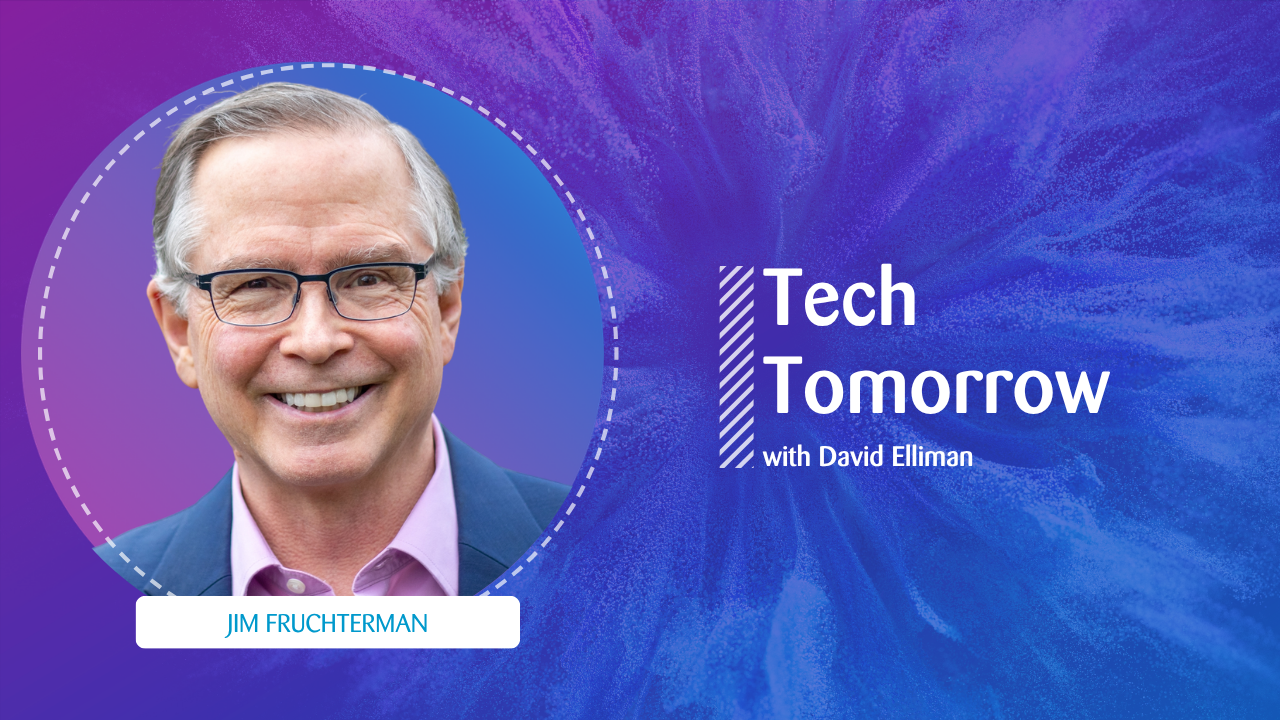
Today I’m joined by Jim Fruchterman, a serial social entrepreneur, podcast host and author of Technology for Good, a book about how nonprofit leaders are using software and data to solve our most pressing social problems. So who better to help me answer the question: is it possible for tech for good to exist within a for-profit model?
JIM FRUCHTERMAN
I see technology for good, or tech for good, as centring the good in tech rather than the profit in tech. In other words, you’ve made a choice that when things are hard, you’re going to choose doing more social good rather than making more money.
DAVID ELLIMAN
So, in your 2025 book Technology for Good, you share the story of founding your first nonprofit. What happened, and what did you learn about the limits of traditional for-profit tech models?
JIM FRUCHTERMAN
Well, for me, the fork in the road was a meeting of my venture capital board for my OCR start-up. At this time we’d launched a product and were at maybe $15 million a year, and we had a new prototype of the reading machine for the blind. This had been a kind of secret side project of the marketing team and the engineering team.
So we had our big scanner on the table in the boardroom. We take a piece of paper, we run it through, it recognises the words on the page, taking it from image bits into a text file. We send it over to a PC and a first-generation voice synthesiser reads it aloud: 'Our Father, who art in heaven', but not that natural sounding. Anyway, the board was excited. The demo worked. And they said, 'Hey Jim, the demo worked. So how big’s the market?' And we said, 'Well, we think it’s about $1 million a year.'
A very uncomfortable silence ensued. Finally one of my investors said, 'I’m not seeing the connection to the $25 million that we’ve collectively invested in this company.' And I’m like, 'Oh, it’ll be great public relations. Our customers will be proud of us for helping blind people. The engineers love it. My marketing team loves it. It’ll be great. It’ll break even.' And the board vetoed it on the spot for excellent business reasons, not great social reasons.
And that was the place where I had a choice in my career. Silicon Valley tells you if it’s a bad idea, you’re supposed to stop doing it. And I didn’t want to. So I talked to my lawyer, who had been kind of cheering me on from the sidelines, and he said, 'Okay, how about I do pro bono legal work for you and we’ll start a deliberately nonprofit tech company — a charity?' So that’s what I did. I started a nonprofit on the side, told my wife I would do it part-time for a year and then hire an executive director. And that was over 30 years ago.
DAVID ELLIMAN
So that journey from your experimentation and discovery of OCR and its applications, and then making that choice between profit and nonprofit — how did that pan out for you? Because obviously there is a very different model that you have to employ. Profit and capitalism is pretty obvious, isn’t it? It’s about making money for your shareholders, and then if you get the space and the chance to do other things, then depending on the outlook of the people involved, there may or may not be other things that are achieved. But a nonprofit normally has a different mission. How did you think about that?
JIM FRUCHTERMAN
Well, because of my background, I looked at traditional charity and just thought, 'All right, I’m obviously not in that area.' So the idea was: can I take the best things from Silicon Valley tech and apply them to social good? And it turned out — I didn’t know any charities like this — but my lawyer and I cooked up this idea that I was going to sell reading machines for the blind, and that was going to be the source of my budget. And it worked.
Within three years, we were a $5 million-a-year break-even charity funded entirely from customer revenue, from margin. And the IRS — our Internal Revenue Service, our tax authorities — were a little confused by this. 'Wait a minute, you’re making a profit.' 'No, charities aren’t supposed to make a profit.' And we’re like, 'Well, it’s only a little bit of profit, and we’re tiny.'
A charity that’s $5 million a year and breaking even, that’s like a barn-burner in the charity sector. We treated our blind users as customers. We built a great product. So we were doing the software engineering on their user experience. We had tech support. We had salespeople. Everything that Silicon Valley does, I’m following three or five years behind and just borrowing the business-model innovations and the tech innovations to go after the 90% of humanity and the planet that aren’t really going to make you billions of dollars.
DAVID ELLIMAN
Related to that, I saw a quote of yours that I thought was interesting to explore: 'Try to do good on purpose rather than evil by accident.' I’d love you to expand on that a little bit, because it strikes me that being specific about your product — if it’s a digital product, providing a good software engineering experience — all those building blocks that we know work in business are still great foundational blocks for anything. And it just so happens that you can then have a bit more control over what it is you are doing and selling. That’s how it occurred to me. Your mantra seemed to be: if you know your business inside out and you know your product really well, then you know that you’re not going to do evil by accident.
JIM FRUCHTERMAN
Yeah. And I think that quote is really about the story of a lot of our big Silicon Valley companies. They set out to do good and then suddenly they try out something that turns out to be evil. Certainly that wasn’t their original goal. And then it turns out that evil, in some cases, pays really well, and so they double down on evil. Why? Because money is the central issue.
So I think that if you’re going to take investor money, and your investors — like most venture capitalists — are really interested in making a lot of money, then you’ve made your bargain and you’re going to follow in this direction. So when I think about companies that don’t go that far, who are more authentic, it’s the B Corporations. There’s also a big movement amongst the tech industry and tech founders called Pledge 1%, where you give 1% of your equity when you’re a start-up company to charity. It’s not worth anything, and then you go public and suddenly you’ve got tens of millions of dollars to give away.
Those companies are making money and doing well, but they’ve actively set aside something to say, 'We have a social responsibility. We’re going to do volunteerism, we’re going to be making grants, we’re going to give deep discounts to nonprofits.' Those companies, to your point, I don’t think are doing evil by accident. I think they create real value and they have a healthier internal culture than the ones I’ve observed that are completely worshipping the almighty Mammon — dollar, pound, euro, whatever it is.
DAVID ELLIMAN
The challenging part of harnessing tech for good is switching focus from profits to other measures of value. And you might reasonably ask whether I’ve seen a successful example of that in my own career. Honestly, yes — more often than people might expect in nearly 40 years in software. Some of the work I’ve found the most rewarding has been with engineering teams in banking, TV, healthcare, public services and so on. Nobody on these projects is talking about the share price. They’re talking about whether a benefits payment lands on the right day, or whether a hospital system stays up so a clinician can do their job.
So in my view, what could leaders of for-profit tech companies be doing to start edging towards a tech-for-good model? I think it begins with making impact a first-class metric sitting alongside revenue and growth, not necessarily somewhere underneath it. That might mean adopting B Corp principles, joining Pledge 1%, or simply giving your engineering teams genuine permission and protected time to work on problems that matter beyond the next quarter.
The companies that do this well don’t treat doing good as a marketing exercise. They build it into how they hire, how they measure and how they govern. As Jim says, it’s a choice — and it’s a choice every leader can start making today.
JIM FRUCHTERMAN
If you pick any industry, banks are not a bad example, right? A bank is a software company that happens to dabble in finance. And it turns out that in a lot of developing countries the banking industry didn’t serve 90% of the populace. Their job was to bank the elite. So there was a giant market-failure gap there, and microcredit and affordable fintech filled those gaps. A lot of those are businesses.
Let’s pick climate as an example. Lots of people want to work on climate. A lot of people chose to work in clean energy. You can make boatloads of money in clean energy, right? So tech for good as a nonprofit is not a religion for me. You choose the corporate form that is most effective in reaching your goals. If I wanted to do more solar panels or wind energy, I would be a for-profit because there’s a gigantic market there and you can make a huge difference in the world and make lots and lots of money for yourself and your investors.
But then you’ll find out that a tiny smallholder farmer in rural Africa can’t afford a solar panel. Okay then, I’m done. But pick a different issue: human rights and civil rights. There is no business model for human rights and civil rights. If you care about women’s rights, great, but you’re not going to make money off that. So that’s going to have to be in the charity zone.
DAVID ELLIMAN
I can think of a couple of examples from the past where private and third sector organisations had worked together on something, profit and nonprofit working together for some sort of joint outcome. The examples that came to mind were really sponsorship models, in that the private sector puts in some form of basis, which might be money, might be skills, which equates to people’s time and therefore money. So there’s a support model.
JIM FRUCHTERMAN
Well, I think it’s a great model. Let’s go back to my OCR company. At the time, we had taken our $40,000 or $50,000 product and reduced it to a $5,000 hardware product that worked for a PC. When I quit, my company was like, 'Oh no, don’t compete with us, don’t hire away.' I said, 'Great, we’ll sign a non-compete and a no-hire.' They gave me a 75% discount on their hardware product. That meant they still made a little bit of profit. They probably marked the product up five times over what it cost them to build it. So a 75% discount still had a profit margin in it.
I became a big customer, and my investors were not against helping blind people. They were against distracting the business away from making money. As long as I was outside and I was a customer, they were like, 'Hey, give him the giant discount. Give him credit.' That’s actually how I financed the business: on credit from my old company that I didn’t pay for 60 days, while I told everyone else, 'I’m a charity, you have to pay up front for the product.'
These dynamics work really well. And one of the things that really surprises people is this: when I go to a big tech company and say, 'I want a free licence to your crown jewels — your product, your software, your technology, your intellectual property' — they say yes 80% of the time. People go, 'Those greedy so-and-sos, why?' And I’m like, they’re immensely proud of the products they’ve created. Tech people are about craft, about solving problems, and the fact that their product is never going to get to Zambia kind of bums them out. If I come to them and say, 'I want to go after a market you’ve already given up on, I want the sleeves off your vest', they go, 'Well sure, why not?' And what do I pay them back with? I go and tell their teams how their product is helping rural Zambians, or kids with disabilities, or women’s-rights activists, or whoever it is. I don’t have to pay them in money. I pay them in stories of how their product made a difference.
DAVID ELLIMAN
That’s really amazing: taking an existing product suite to a market that the core company are not interested in. They might say, 'Well, if you are finding that market, then maybe we want part of that', but…
JIM FRUCHTERMAN
And that can be a problem, Dave. This has been a problem. I’m going to pick Microsoft and Oracle. Microsoft and Oracle both gave their software away for free to the nonprofit sector for many years, and they’ve both clawed it back. Because when they’re under pressure and they suddenly realise, 'Wait a minute, we’re giving away a market that now looks like it’s worth hundreds of millions, or even low billions — we can’t afford to give that away.'
Salesforce created a .org that was a charity and contributed this ability to get Salesforce for free. And then, whatever it was, 10 years later, they said it was a bad idea. They had to pay $300 million to buy the charity back into the company, because when you’ve given something to charity, you don’t get to just take it. You have to pay cash to a foundation to make up for the fact that you’re taking this asset back.
Microsoft used to give really deep discounts to nonprofits. No longer. If you actually prove that there’s a business, business will come and bring it back. But maybe we bridged a 10- or 20-year gap between when it was clearly not a business and helped a whole bunch of people, and then the fact that Microsoft is treating it like a business; okay, most nonprofits can afford it. So okay.
DAVID ELLIMAN
Tech for good is all about getting people to think outside of simply making money. As a software engineer myself, do I agree that tech teams are, on the whole, proud of the products and happy to offer deep discounts if it means exploring new markets? I’d actually go a little bit further than that. Most of the engineers I know don’t get out of bed for the share price. They get out of bed because they’ve built something they believe is genuinely useful, or they’ve enjoyed building it.
And when you tell them that thing is now in the hands of a clinician in rural Africa, or a teacher in a school that could never have afforded the licence otherwise, you can see them stand a little taller. Jim is absolutely right about that. So what else should for-profit tech leaders be thinking about when it comes to helping nonprofits bring their prices down? My honest answer is: thinking decades, not quarters. Jim’s point about Microsoft, Oracle and Salesforce clawing back nonprofit pricing is a cautionary tale here. If you give something away and then withdraw it at the moment it looks valuable, you haven’t really helped. You’ve just delayed the problem and damaged trust on the way out.
Real generosity in this space looks like long-term commitments, open-source contributions that you actually maintain, proper engineering support behind the discounted licence, and a willingness to share skills as well as software. That’s the difference between a marketing line and a movement. So more broadly, what are Jim’s thoughts on what else leaders could be doing in this space?
JIM FRUCHTERMAN
Well, I think a lot of them don’t want to. So, at one end of the spectrum, you need to regulate them. Just like we regulate cigarettes or alcohol, so they can’t be provided to people under 21 or 18, or whatever your standard is. And the Australians, to pick an example, have banned social media for young teens and below. So I think at one end society needs to actually say, 'Yeah, not that.'
Right now we’re doing that in the areas that are in some ways the clearest. Kids are suffering. We should stop kids from suffering. So I’m a big believer that when the tech industry has shown that it does not care, the secret stuff comes out and they’re like, 'Yeah, yeah, we’re not going after teens.' Oh yeah, we’re totally going after teens. The secret memo is all there.
Then I think there’s a lot of products that are less problematic, and the job of those companies is just to do a good product. I don’t need a human-rights word processor if it’s affordable. Then companies can make these other decisions to say, 'I’m going to be a B corporation. I’m going to be a Pledge 1% company. I’m going to make my product available to nonprofits for a discount, or give that free licence to someone like Jim to use that technology.' It’s a spectrum, right?
I’m on the nonprofit side, but I run businesses. You scratch the surface, I look like a SaaS company. I’m a SaaS company with 10 people, but hey, it’s a SaaS company. It’s got all those roles covered. Sometimes one person has more than one role, but okay. And then you get further and further down and you go, okay, then there’s economic-development charities. They’re trying to train people who didn’t finish their education, or just came out of prison, or are developmentally disabled, or whatever. And then you’ve got pure charity. You just got hit with a typhoon or a hurricane and you need someone to give you water and a bed and food. Great.
But I think this dynamic is: what problem are you solving, what’s a good way to solve it, and what’s the right model to pick? I wrote a paper years ago called 'For Love or Lucre: whether to start a nonprofit or a for-profit when you have an idea that does social good', and the answer is: the one that will work best.
A goal of writing a book, as far as I know, the first book on how to start a tech company that doesn’t make money, was exactly that. There are thousands of books on how to get rich with tech. This is a book about how to make impact with tech, and it’s all about what are the great things in the tech industry that we want to copy: agile, lean, human-centred design, rapid prototyping. Those things work, and they work better than the way the charity sector usually solves problems, which is: let’s think about this and decide what poor people need, as opposed to let’s actually work with a whole bunch of poor people and figure out what actually works for them.
So I want to highlight all that good stuff: the fact that you can run a business, that you have to have marketing, that you have to do tech support. I want to make sure that people have all those things. But when a tech person comes up with an idea that can change the world and it is non-investable by a big tech company or investors because it doesn’t make enough money, they can still do it and still make a living at it, they just won’t get rich. And I think a lot of people will choose that if they know it’s an option.
DAVID ELLIMAN
So to bring this to an end: if we ask whether tech for good can really exist within a for-profit company, then if I was to guess at your answer, you’d probably say yes; if the intention is there, and yes if the model is appropriate to deliver what it is that you want to do. But there seems to be the need for that central mission to want to do the things that you’re effectively doing as a result of not necessarily making a lot of money.
JIM FRUCHTERMAN
Yeah. And the other thing is that we in tech for good couldn’t survive if there wasn’t a thriving tech industry inventing the core technologies, building the open-source technology. We’re not going to justify creating a $5 billion foundry for chips as the nonprofit sector. We’re just not that big. So we depend on it and we need the goodwill from a lot of tech leaders to really maximise our impact.
But in some cases I don’t need the goodwill of whoever makes that mobile phone. I can write an app for it and they don’t really care, and that’s okay because they’ve created something that is a platform that enables me to go off and use that platform for something extremely cool — like helping a dyslexic kid learn to read, or helping a farmer figure out why her crops are dying, whatever it might be. That’s made possible because we have app stores and smartphones.
DAVID ELLIMAN
Thank you for listening to Tech Tomorrow, brought to you by Zühlke. If you’d like to learn more about what we do, you can find links to our website and more resources in this episode’s show notes. Until next time.